
Book
The Twin Flame Paradox: Why Our Deepest Soul Connections Are Often the Most Destructive

If you spend any amount of time on modern social media platforms—particularly in the spiritually curious corners of TikTok and Instagram—you have likely encountered the concept of the “twin flame.” In 60-second clips set to ethereal music, influencers paint a picture of the ultimate romantic ideal: a soul split in two across time and space, destined to reunite in a blaze of cosmic glory.
It sounds like the perfect love story. It sounds like a romance novel waiting to be written. But as anyone who has actually experienced the crushing, unexplainable weight of a profound karmic tie will tell you, meeting your twin flame is rarely a rom-com.
More often than not, it is a crucible.
This beautiful, terrifying reality is the beating heart of Dear Nathalie, a brilliant new work of sacred realism by author Tanya Kazanjian. Told through letters, journals, and fragmented memories, the novella strips away the pastel-colored aesthetics of modern internet spirituality to reveal the raw, often agonizing truth of what happens when two souls collide. It asks a question that most of us are too afraid to answer: What if the person who understands your soul the most is the very person who destroys the life you’ve so carefully built?
The Myth of the Perfect Match
We are culturally conditioned to believe that true love brings peace. We are taught that when you meet “the one,” the jagged edges of your life will suddenly smooth out. The right partner will help you buy a house, raise children, share a bank account, and settle into a comforting, predictable routine.
In Dear Nathalie, this societal ideal is perfectly represented by Gregory and his long-time partner, Suzanne. They share a home, they share children, and they share a life that is, by all outward appearances, secure. It is the kind of relationship built on what Gregory calls “a ceaseless recalibration, a quiet refusal to let the vessel sink.”
But safety and spiritual fulfillment are not always the same thing.
Enter Nathalie. When Gregory meets her, there are no fireworks, no cinematic declarations of love. There is simply “recognition shock.” It is the sudden, breath-stealing realization that he has known this woman before. Nathalie, a poet and an empath carrying the heavy wounds of trauma and a brilliant, restless mind, experiences it even more viscerally. She doesn’t just see a new colleague; she feels her own self-concept unraveling in his presence.
This is the great paradox of the twin flame. Instead of bringing peace, the connection brings an earthquake. It does not fit neatly into the three-dimensional world of mortgages, corporate jobs, and dinner parties. It defies logic. It demands a level of vulnerability that the human ego is rarely prepared to handle.
Ego Decomposition: The Price of Meeting Your Mirror
In the spiritual literature surrounding twin flames, there is a concept known as “ego decomposition.” It is the process by which the false layers of your identity—the masks you wear to survive in society—are burned away by the intensity of your connection with your mirror soul.
Kazanjian captures this terrifying psychological state with stunning accuracy. Nathalie writes to Gregory, “My sense of self has been crumbling in ways I never imagined possible. Everything that once felt stable in me—the tidy categories of who I thought I was, how I moved through the world, what I could expect of myself—has been shattered into fragments.”
For readers who have navigated the murky waters between profound spiritual awakening and acute psychological distress, Nathalie’s journey is deeply resonant. She goes to a psychiatrist seeking answers for her overwhelming emotions and sensory overloads. She is told she has PTSD, mild depression, and a vivid imagination.
But modern medicine often lacks the vocabulary for matters of the soul. How do you prescribe a pill for the sensation of carrying emotions from a past life? How do you medicate the feeling of being bound to someone via quantum entanglement?
The book brilliantly blurs the line between mental health and mysticism. It forces the reader to sit in the uncomfortable, awe-inspiring space of “sacred realism”—a place where mundane things like office meetings and abandoned churches coexist with auras, astrological fate, and angels falling in the snow.
The Ghost in the Marriage
Perhaps the most tragic element of the twin flame dynamic is the collateral damage it leaves in its wake. Because these connections are so intense, they often make ordinary, earthly relationships feel incredibly hollow by comparison.
Through the diaries of Suzanne, Gregory’s partner, we get a front-row seat to the devastation caused by an unconsummated, spiritual love affair. Suzanne is not fighting another woman for her husband’s physical affection; she is fighting a ghost for his soul.
When Gregory finally proposes to Suzanne after sixteen years, using an heirloom ring given to him by Nathalie, the gesture backfires catastrophically. The ring becomes a poisoned apple. It is a symbol of the profound spiritual intimacy Gregory shares with Nathalie—an intimacy he has never managed to build with the mother of his children.
Suzanne’s journal entries are a masterclass in the quiet agony of the modern marriage. She realizes that she and Gregory have been “painting over cracks,” preferring comfort to confrontation. But when faced with the undeniable depth of Gregory and Nathalie’s bond, Suzanne realizes she wants that depth for herself. She realizes that living “safely” is no longer enough.
In this way, the twin flame acts as a catalyst not just for the two souls involved, but for everyone in their orbit. The connection demands authenticity. It forces every lie, every compromise, and every half-hearted vow up to the surface to be examined.
Are We Meant to Stay Together?
If there is one profound takeaway from Dear Nathalie, it is the realization that soulmates are not always meant to stay together in the traditional sense.
Sometimes, a soulmate comes into your life simply to wake you up. They arrive to show you the parts of yourself you have hidden away, to heal old karmic wounds, and to remind you that the universe is far larger, stranger, and more beautiful than you ever dared to believe.
Nathalie and Gregory do not get a fairytale ending. Their story is marked by grief, separation, and ultimate tragedy. Yet, through Kazanjian’s gorgeous prose and deeply philosophical lens, we see that the bond survives. It survives death. It survives reincarnation. It survives the stubborn passage of time.
“Twin flames, you once said,” Gregory reflects after Nathalie’s passing. “Two souls cut from the same fire, destined to seek each other across lifetimes, burning too brightly to ever truly fade.”
For anyone who has ever loved someone in a way that defied explanation, Dear Nathalie offers a profound sense of validation. It is a reminder that while the twin flame trap might break your life apart, it does so only to set your spirit free. It is a haunting, poetic exploration of love in its most primal, uncompromising form—and a warning that once you look into the eyes of your mirror soul, you can never look away.
Media Details:
Amazon: DEAR NATHALIE
Author: Tanya Kazanjian
Website: www.tanyakazanjian.com
Written in partnership with Tom White


Book
From Hollywood Insiders to Trauma Storytellers: Why Breaking Jenny Had To Be Told

In Hollywood, stories are often built around clean endings. Heroes. Villains. Redemption arcs that arrive right on cue.
But real life rarely works that way.
That realization became impossible to ignore for filmmaker, screenwriter, and author Nic Fairbrother and Emmy® Award-winning filmmaker and best-selling author Shane Stanley while writing Breaking Jenny, a survivor-led memoir releasing May 12 that blends personal testimony with investigative reconstruction.
At the center of the book is “Jenny” (name changed for safety reasons), a woman whose relationship with her fiancé, Max, slowly unraveled into something far darker than she initially understood. After Max’s sudden death, Jenny discovered hidden phones, laptops, sinister journals, and digital archives concealed beneath the floorboards of their home, evidence that pointed to a life she never knew existed.
As the materials came together, what initially appeared to be deception revealed a far more complex and disturbing pattern of control and instability. Some of what Jenny uncovered pointed to escalating behavior that suggested Max’s plan to potentially murder Jenny, raising questions not just about who Max was, but how long the reality had gone unnoticed.
For Stanley, the material was not distant subject matter.
He knew Max personally.
In fact, Max had once been one of his closest friends.
“I had known Max since we were kids, and when you have that kind of history, you don’t see clearly,” Stanley explained. “You see what you want to preserve. What changed was realizing that the version of him I held onto and the reality of what Jenny experienced couldn’t coexist.”
That emotional proximity became one of the defining tensions of the book itself.
Rather than approaching the material as outside observers, Fairbrother and Stanley found themselves confronting uncomfortable questions about perception, accountability, and the ways harmful behavior can remain hidden in plain sight for years.
“Proximity actually made it harder to tell, not easier,” Stanley said. “You’re constantly questioning your role, what you saw, what you missed, what you chose not to see. But ultimately, what made it necessary was understanding stories like this don’t exist in isolation. They repeat.”
While Breaking Jenny contains many of the elements associated with psychological thrillers and true crime narratives, its focus ultimately centers on something more intimate: understanding how coercive control develops gradually over time, often without immediate recognition from the people inside it (or around it).
For Fairbrother, telling the story responsibly became just as important as telling it honestly.
“We chose to focus on Jenny’s healing journey and make it inspirational rather than exploitative,” Fairbrother said. “There were so many stories she shared with us that we ultimately decided to leave out, simply because we didn’t want to cross the same boundaries that so many people in her life already had.”
That balance shaped the tone of the entire project.
Built from extensive documentation, including private journals, recovered digital materials, financial records, and hundreds of thousands of text messages, the book reconstructs not just the collapse of a relationship, but the psychological environment that allowed it to continue for so long.
Both authors describe the experience of writing the book as deeply personal and, at times, emotionally destabilizing.
“I’ve been hearing different versions of this story my entire life — from women, from men, and sometimes, from my own mouth,” Fairbrother said. “Society is sick of the abuse. It’s time to drag the monsters out from under the bed and into the light.”
That desire to illuminate patterns rather than sensationalize them became central to the project’s purpose.
Instead of asking why someone stays, Breaking Jenny examines how manipulation often builds slowly through emotional conditioning, dependency, confusion, loyalty, and the gradual shifting of boundaries.
“It challenged a lot of assumptions I think people carry,” Stanley said. “That they would recognize abuse immediately, that they would act decisively, that it’s always clear-cut. What you start to see instead is how gradual it is. How it builds.”
For Jenny, according to both authors, the goal was never simply to recount what happened to her. She wanted the story to help others recognize warning signs before they became trapped inside similar dynamics themselves.
“Once she came out the other side, what mattered most to her was that her experience could serve as a kind of roadmap,” Stanley explained. “Something that might help someone recognize the signs earlier and choose a different path.”
That focus on recognition gives Breaking Jenny much of its emotional weight.
Because the story’s most unsettling revelations are not just about secrecy or deception. They are about how easily dangerous dynamics can camouflage themselves as familiarity, intimacy, or even love.
“Sometimes abuse is buried so deeply in our subconscious that we don’t recognize it until decades later,” Fairbrother said. “What gives me hope is that there are now far more tools and a much greater awareness to help survivors process those experiences — and to help prevent this kind of insidious behavior from continuing unchecked.”
For two storytellers whose careers were built in entertainment, Breaking Jenny became something very different from traditional narrative work.
Not an escape. A confrontation. And one they felt could no longer remain private.
Breaking Jenny is available now in paperback, e-book, and Kindle on Amazon and BreakingJenny.com.
Written in partnership with Tom White
Book
KIMI·ISMS AND THE ART OF LIVING OUT LOUD: A MODERN COMPASS FOR AN UNRULY WORLD
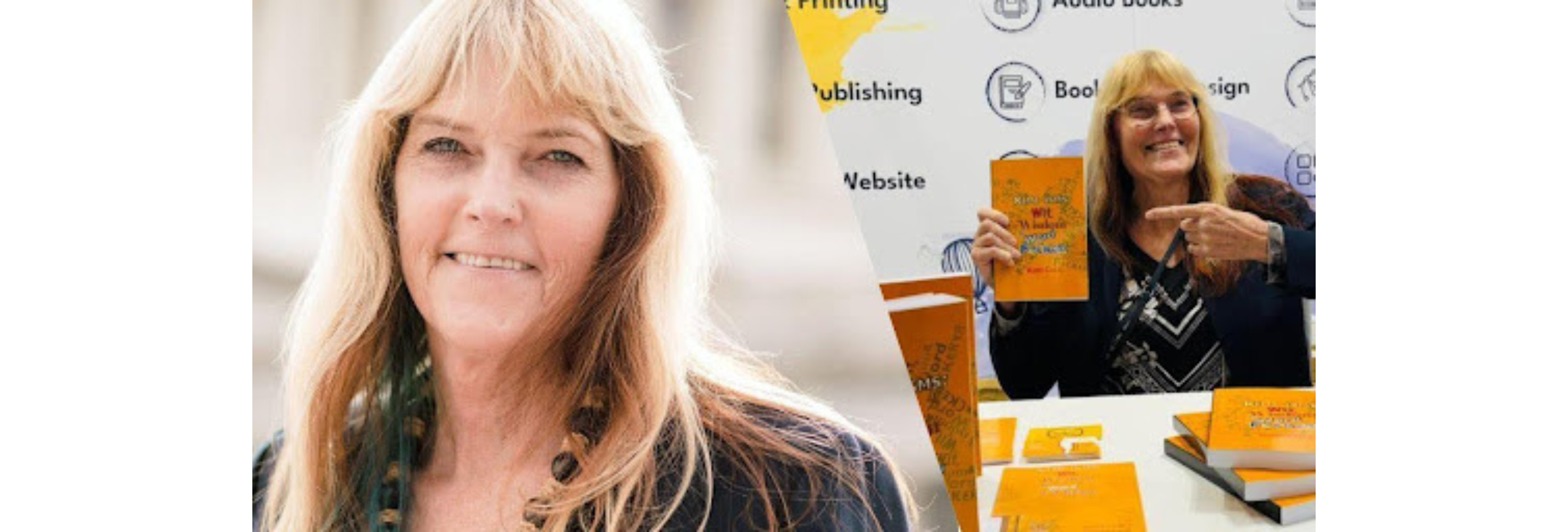
It’s hard to find a voice that cuts through the cacophony with both clarity and compassion these days, when noise is often mistaken for knowledge and speed is often misunderstood for development. Kimi Cole, the author of Kimi·isms: Wit, Wisdom & Word F*ckery gives us just that: a body of knowledge that comes not from theory but from decades of living, fighting for social justice, reinventing herself, and searching for the truth. Her words don’t float above life; they stroll right next to it.
The book is not a memoir, and it is not a self-help book in the usual sense. Instead, it’s a carefully chosen collection of one-liners, stories, philosophical snippets, political thoughts, and hard-won bits of wisdom that the author has picked up over the years while living in a world that often punishes authenticity and demands conformity. What you get is a complex picture of a woman who has experienced society from both the inside and the outside. She has led, listened, stumbled, rebuilt, and risen not quietly, but with purpose.
Readers might think they’re about to read a lighthearted book of funny quotes at first. But the way the material is put together shows otherwise. The reader goes through a wide range of topics, from “General Inspiration” to “Human Rights Trans,” from “WF Sarcasm” to “Philosophical Practical.” Some entries feel like a soft push. Some hit with the force of a truth that has been avoided for a long time. Cole often says that life is not linear and that wisdom does not come in neat packages. This is why the range is there.
One of the things that makes Kimi·isms stand out is that it doesn’t just sit back and let things happen. Cole doesn’t give lectures; she talks. She doesn’t tell people what to think; she asks them to think. Like when she said, “Your actions are so loud, I can’t hear your words,” the book repeats its own point: meaning is not found in performance but in practice. In fact, the repeated lessons about honesty, responsibility, and personal power seem especially relevant in a time when people are more interested in quick fixes and empty words.

Cole writes from a place of strong hope, but not the kind that makes things sound good. She is hopeful because she is strong. She understands from experience that problems don’t usually come with a warning or a good time. “Life has a habit of bringing challenges that are neither convenient nor hoped for,” she says. She reminds readers that having trouble is not a sign of failure, but an invitation to rise above what formerly seemed insurmountable. The author’s greatest strength in these musings is that she combines realism and hope in a way that never takes away from either.
But Kimi·isms is more than just support. It is also a strong critique on society. Cole has long fought for equality, inclusion, and human decency. Her direct involvement with systematic discrimination, notably transphobia and racism, is very honest. She doesn’t give in to pressure. She doesn’t sugarcoat hard truths. Instead, she turns intricate problems in society into strong assertions that are easy to understand and very clear. This is where the book goes from being personal wisdom to being a record of culture.
For example, her views on activism go against theatrical indignation and stress the need for long-term action. This is a view that is becoming less common in an age where people are more interested in shallow engagement. She says, “If something needs to be done, the question is, are you someone or are you nobody by not doing anything?” These remarks are especially true in a world full of complaints and lacking in solutions.
But the book’s most remarkable characteristic is its humanity, even though it is so cutting. Cole writes about friendship in a way that shows she has always valued real human connection. She talks about mentors who helped her, teachers whose lessons she still remembers, and friends who stayed and friends who left. She thinks about gratitude as much as she thinks about challenges, which strengthens her opinion that a balanced existence is one that is based on both realism and appreciation.
The comedy, which is sardonic, irreverent, and unabashedly blunt, serves a higher purpose. Cole doesn’t use sarcasm to be mean; instead, she uses it to show how smart she is. It takes away weapons. It shows things that don’t make sense. It shows how silly people can be and makes people laugh at themselves instead of at others. She can turn a phrase like a craftsman turns wood, giving it both beauty and strength. In her mind, humor isn’t a way to get away from the truth; it’s one of the best ways to get it across.
The way the book is put together lets readers go wherever they want. There is no set order or topic that must be followed. But the overall effect is not broken up. It has an orchestra in it. No matter what page they open, readers find a voice that is both personally personal and universally relatable. Some insights are only one sentence long. Some others happen like an internal monologue that is cut off in the middle of an idea. They make up a living manuscript that shows how unpredictable real life can be.
Maybe what makes Kimi·isms so interesting is that it doesn’t try to hide the fact that things are complicated. Cole accepts the paradoxes, uncertainties, and changing points of view that come with living in the modern world. She is proud of how much she has grown and how motivated she is to learn. She makes fun of people who stick to one point of view just because it’s what they know. She tells people to change their habits, look at things from different angles, and challenge what they think they know. She believes that thinking is not a choice; it is a duty.
Cole’s thoughts on her own journey, which include personal challenges, professional reinvention, and social advocacy, are not confessions but rather insights. She knows that the real value of an event is not in the experience itself, but in what it teaches us about how to move forward. Her worldview, which she came to after seeing hundreds of things, can be summed up in one message that keeps coming up: life is for living fully, consciously, and with courage.
Ultimately, Kimi·isms: Wit, Wisdom & Word F*ckery transcends a mere collection of clever sayings. It is a modern guide to living with purpose in a world that often favors apathy. It is hard to care more, think more profoundly, and act more bravely. It reminds us that wisdom isn’t just for gurus or professors; it’s in every instant of our lives if we pay attention.
Kimi Cole doesn’t want people to agree with her. She tells them to wake up. And that invitation is what makes this amazing work so powerful.
Written in partnership with Tom White
-

 4 years ago
Maggie Jenson Is Empowering People Battling Addiction
-

 3 years ago
Latino Pulse in LA’s Hip-Hop Heart: The FACEvsIT Evolution
-

 Fashion3 years ago
From Brothers to Business: The Inspiring Journey of YoungLA
-

 Entertainment3 years ago
From ‘Cold’ Streetwear to Cosmic Dreams: The Ryley Gauthier Odyssey
-

 Crypto5 months ago
The Real Story Behind teemchase’s Real Estate, Music, and Crypto Empire
-

 5 years ago
Demonstrating the power of social media- British bombshell, Bonnie Locket:
-

 Business2 years ago
Iron Wallet: The Ultimate Solution for Financial Independence
-

 Entertainment3 years ago
Check out Lil Wayne’s New Artist, Drizzy P