
Book
From Hollywood Insiders to Trauma Storytellers: Why Breaking Jenny Had To Be Told

In Hollywood, stories are often built around clean endings. Heroes. Villains. Redemption arcs that arrive right on cue.
But real life rarely works that way.
That realization became impossible to ignore for filmmaker, screenwriter, and author Nic Fairbrother and Emmy® Award-winning filmmaker and best-selling author Shane Stanley while writing Breaking Jenny, a survivor-led memoir releasing May 12 that blends personal testimony with investigative reconstruction.
At the center of the book is “Jenny” (name changed for safety reasons), a woman whose relationship with her fiancé, Max, slowly unraveled into something far darker than she initially understood. After Max’s sudden death, Jenny discovered hidden phones, laptops, sinister journals, and digital archives concealed beneath the floorboards of their home, evidence that pointed to a life she never knew existed.
As the materials came together, what initially appeared to be deception revealed a far more complex and disturbing pattern of control and instability. Some of what Jenny uncovered pointed to escalating behavior that suggested Max’s plan to potentially murder Jenny, raising questions not just about who Max was, but how long the reality had gone unnoticed.
For Stanley, the material was not distant subject matter.
He knew Max personally.
In fact, Max had once been one of his closest friends.
“I had known Max since we were kids, and when you have that kind of history, you don’t see clearly,” Stanley explained. “You see what you want to preserve. What changed was realizing that the version of him I held onto and the reality of what Jenny experienced couldn’t coexist.”
That emotional proximity became one of the defining tensions of the book itself.
Rather than approaching the material as outside observers, Fairbrother and Stanley found themselves confronting uncomfortable questions about perception, accountability, and the ways harmful behavior can remain hidden in plain sight for years.
“Proximity actually made it harder to tell, not easier,” Stanley said. “You’re constantly questioning your role, what you saw, what you missed, what you chose not to see. But ultimately, what made it necessary was understanding stories like this don’t exist in isolation. They repeat.”
While Breaking Jenny contains many of the elements associated with psychological thrillers and true crime narratives, its focus ultimately centers on something more intimate: understanding how coercive control develops gradually over time, often without immediate recognition from the people inside it (or around it).
For Fairbrother, telling the story responsibly became just as important as telling it honestly.
“We chose to focus on Jenny’s healing journey and make it inspirational rather than exploitative,” Fairbrother said. “There were so many stories she shared with us that we ultimately decided to leave out, simply because we didn’t want to cross the same boundaries that so many people in her life already had.”
That balance shaped the tone of the entire project.
Built from extensive documentation, including private journals, recovered digital materials, financial records, and hundreds of thousands of text messages, the book reconstructs not just the collapse of a relationship, but the psychological environment that allowed it to continue for so long.
Both authors describe the experience of writing the book as deeply personal and, at times, emotionally destabilizing.
“I’ve been hearing different versions of this story my entire life — from women, from men, and sometimes, from my own mouth,” Fairbrother said. “Society is sick of the abuse. It’s time to drag the monsters out from under the bed and into the light.”
That desire to illuminate patterns rather than sensationalize them became central to the project’s purpose.
Instead of asking why someone stays, Breaking Jenny examines how manipulation often builds slowly through emotional conditioning, dependency, confusion, loyalty, and the gradual shifting of boundaries.
“It challenged a lot of assumptions I think people carry,” Stanley said. “That they would recognize abuse immediately, that they would act decisively, that it’s always clear-cut. What you start to see instead is how gradual it is. How it builds.”
For Jenny, according to both authors, the goal was never simply to recount what happened to her. She wanted the story to help others recognize warning signs before they became trapped inside similar dynamics themselves.
“Once she came out the other side, what mattered most to her was that her experience could serve as a kind of roadmap,” Stanley explained. “Something that might help someone recognize the signs earlier and choose a different path.”
That focus on recognition gives Breaking Jenny much of its emotional weight.
Because the story’s most unsettling revelations are not just about secrecy or deception. They are about how easily dangerous dynamics can camouflage themselves as familiarity, intimacy, or even love.
“Sometimes abuse is buried so deeply in our subconscious that we don’t recognize it until decades later,” Fairbrother said. “What gives me hope is that there are now far more tools and a much greater awareness to help survivors process those experiences — and to help prevent this kind of insidious behavior from continuing unchecked.”
For two storytellers whose careers were built in entertainment, Breaking Jenny became something very different from traditional narrative work.
Not an escape. A confrontation. And one they felt could no longer remain private.
Breaking Jenny is available now in paperback, e-book, and Kindle on Amazon and BreakingJenny.com.
Written in partnership with Tom White


Book
He Never Said Goodbye. He Just Stopped Coming Home.
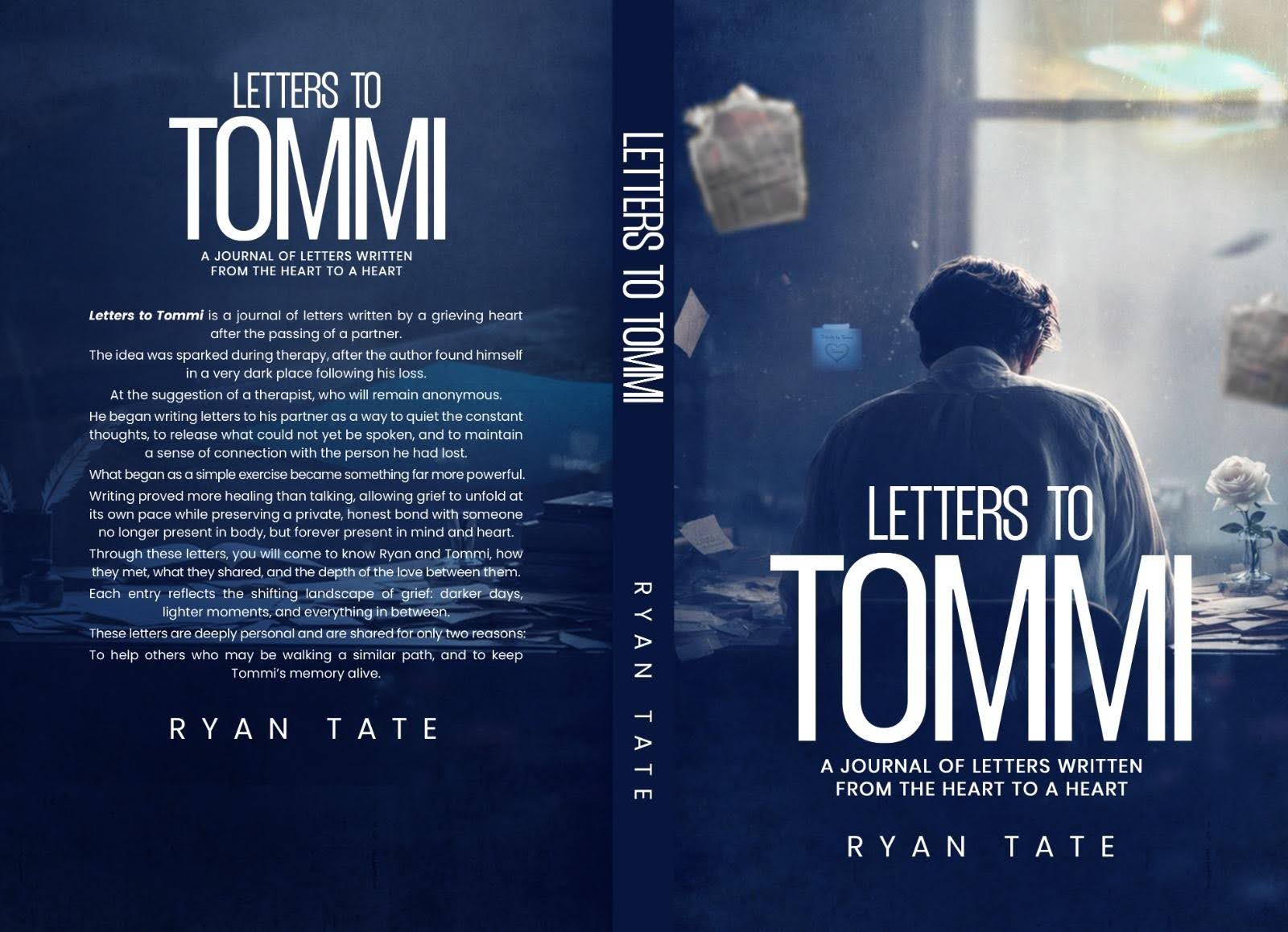
Some love stories don’t end. They just change where they live.
The Day Everything Went Quiet
In Letters to Tommi by Ryan Tate, a man comes upstairs to wake his partner for dinner. He finds him there, on the bed, still. No warning. No goodbye. Just the ordinary cruelty of a Tuesday afternoon that became the worst day of his life. Tommi — warm, funny, tall, Finnish, the man who hid little blue Post-it notes in jacket pockets and coat linings for Ryan to find — was gone. A cardiac arrest. Instant. And Ryan was left standing in a silence that has no name.
What do you do with a love that has nowhere to land?
He Kept Texting Him Anyway
Most people would have deleted the number. Ryan kept texting it.
“Hey Tom Tom, I can’t think what to cook for dinner, the kitchen was always your domain, any ideas?”
He knew there would be no reply. He said so himself: brain freeze, natural instinct, or hoping? But the instinct to reach for Tommi never switched off, because love doesn’t come with an off switch. Not the real kind.
Ryan slept three days on his side of the bed, three days on Tommi’s, one day in the middle. He kept buying daffodils because they reminded Tommi of spring. He still wore the white gold chain Tommi placed in his hand on a bridge on a cold winter night, when he asked Ryan to be his husband. He said it would never leave him. It hasn’t.
This is what Letters to Tommi understands that most books about grief get completely wrong. Love doesn’t end at death. It just loses its address.
Stop Telling Grieving People to Move On
Ryan’s friends meant well. They always do.
“Time will make it easier.” “You need to start living again.” “You were single before and fine.”
He forwarded every single one of those messages to Tommi’s phone. With barely disguised fury.
Because here is what nobody tells you about losing someone you were genuinely, completely, all-in in love with. The grief doesn’t move in stages. It moves like weather. Some mornings, he cleaned all eight rooms of the house to Tommi’s standard and felt almost steady. Some Friday nights, he sat alone with red wine and a Chinese takeaway for one and felt the darkness press in from every corner. Some nights, he wrote letters at 2am. Some nights, he found a hidden Post-it note in Finnish in his coat pocket and translated it with shaking fingers.
None of that is dysfunction. All of that is love, still doing what love does. Showing up, even when the person is gone.
The Truth This Book Tells
Letters to Tommi by Ryan Tate is not a self-help book. It has no five-step plan. It doesn’t promise you’ll be fine by spring.
What it does is sit beside you. The way Tommi used to sit beside Ryan, without fixing anything, without needing big words, just present. Just there.
Ryan wrote these letters for two reasons. To help others walking the same road. And to make sure the world doesn’t forget a big-eyed, glasses-wearing, sauna-loving, wardrobe-raiding Finnish man who made every room feel warmer just by being in it.
He succeeded on both counts.
If you have ever loved someone so completely that losing them broke something in you that hasn’t healed quite right, this book was written for you.
Some loves don’t fade with time. They just change where they live.
Letters to Tommi by Ryan Tate — because some stories deserve to be read, remembered, and kept. Available now on Amazon. Begin Your Reading Journey.
Media Details:
Client Name: Ryan Tate
Website Link: https://letterstotommi.com/
Kobo Live Link: https://www.kobo.com/us/en/ebook/letters-to-tommi?sId=105b70ca-3aaa-42bf-82a8-3ced21abc145&ssId=uW_c-Gs9g8ssSt-CAapK2&cPos=1
Written in partnership with Tom White
Book
Reading Charleston Before Visiting: How Fiction Reveals the City’s History, Culture, and Stories

Paul Attaway (Source: Paul Attaway)
Why Read Fiction Before Visiting Charleston?
Reading fiction before visiting Charleston, South Carolina can help travelers better understand the city’s history, culture, social traditions, and literary heritage before they arrive. Southern mystery author Paul Attaway believes Charleston novels offer insights that guidebooks cannot, allowing readers to experience Charleston through the people, relationships, and conflicts that have shaped the city across generations. For travelers interested in literary tourism, Charleston fiction provides context that transforms a sightseeing trip into a deeper cultural experience.
Charleston has long been recognized as one of America’s most significant literary destinations. Its colonial history, preserved architecture, coastal Lowcountry culture, and complex social legacy have inspired generations of writers across Southern fiction, historical fiction, legal thrillers, and family dramas. For many travelers, novels provide cultural context that complements the city’s historic landmarks.
Recent travel trends reflect growing interest in literature-led tourism, with readers increasingly seeking destinations connected to novels that immerse them in local history and identity. Charleston, Attaway believes, has long occupied that space. In his view, writers have returned to the city for generations because its streets preserve centuries of triumph, hardship, ambition, and inherited memory. Attaway sees those layers as impossible to separate from the visitor experience. Literary tourism allows travelers to connect physical locations with the characters, events, and cultural histories represented in books.
“You can stand on Rainbow Row or walk the Battery, but fiction gives you access to the conversations that happened behind those doors. It lets you meet the people who carried Charleston through generations,” he says.
Many visitors searching for books about Charleston, South Carolina, expect picturesque scenery wrapped in nostalgia. Attaway believes those expectations overlook the city’s literary richness. According to him, Charleston has inspired works that examine class, legacy, justice, faith, and family, placing it alongside celebrated literary settings. Each setting becomes memorable because readers experience its moral tensions alongside its architecture. This connection between place and storytelling has made Charleston a compelling setting for authors exploring Southern identity and generational change.
How Paul Attaway Uses Charleston as a Character
Attaway follows that tradition through Blood in the Low Country, where Charleston functions as far more than scenery. Blood in the Low Country is a Southern family mystery set in Charleston that explores reputation, inherited privilege, justice, and the lasting effects of family expectations. The novel presents southern family drama rooted in expectations surrounding reputation, inherited privilege, and painful personal history. Rose Atkins’ determination to secure acceptance within Charleston society gains meaning because the city itself places enormous weight on ancestry and appearance. Readers witness how private struggles unfold beneath polished social rituals, offering visitors a perspective they would never find on a historic house tour.
Those observations continue through Blood Rivalry, where legal battles expose political influence accumulated across decades. The novel operates as a legal thriller, yet its courtroom conflicts reveal broader questions about institutional power and public image. Blood Rivalry is a Charleston-based legal thriller that examines political influence, corruption, and the lasting impact of powerful family networks.Attaway believes Charleston’s history naturally lends itself to stories where personal ambition collides with civic legacy.
Southern Gothic Themes in the Atkins Family Saga
The Atkins Family Saga also embraces traditions of Southern Gothic suspense, although Attaway approaches the genre through character instead of spectacle. Hidden motives, inherited trauma, moral compromise, and difficult redemption drive his narratives. Readers familiar with the works of Pat Conroy or even the psychological landscapes found in William Faulkner will recognize how Southern fiction often asks people to confront the past before imagining a future.
Attaway argues that readers searching for a meaningful Charleston travel reading list should include novels willing to expose uncomfortable truths alongside celebrated landmarks. “Every beautiful city has stories people would rather forget. Ignoring those stories gives you an incomplete picture,” he explains.
That philosophy shapes Attaway’s Atkins Family Saga. Across the series, Attaway explores recurring themes of family legacy, justice, corruption, forgiveness, and the influence of history on modern communities. Each Southern novel explores family secrets and corruption without reducing Charleston to crime alone. Eli Atkins’ wrongful accusation, Walker’s legal fight against a powerful political dynasty, and the burdens carried across generations all reflect larger questions about justice, forgiveness, and community. Visitors who encounter Charleston after reading those stories may notice details others pass without thought, from historic churches to courthouse steps where public life and private conflict have long overlapped.
Why Literary Tourism Continues to Grow
Attaway also leans into the appeal of the small-town southern mystery, even while Charleston itself has grown into an internationally recognized destination. Communities throughout the Lowcountry remain deeply connected, allowing relationships, loyalties, and old grievances to ripple through every investigation. Those dynamics create the foundation for the deep south crime drama woven throughout his novels.
In Attaway’s view, literary tourism succeeds because memorable places become richer through narrative. Charleston offers exceptional architecture, celebrated cuisine, and remarkable preservation, yet Attaway maintains that its greatest attraction remains its people and the stories they continue to inherit. Reading before arriving allows visitors to recognize those invisible threads, transforming familiar landmarks into places where history still feels personal. By the time travelers reach Charleston’s cobblestone streets, Attaway argues that the city can already feel inhabited, not simply visited. For travelers interested in Charleston history, Southern fiction, and literary tourism, reading before visiting provides a deeper understanding of the city’s people, traditions, and stories beyond its famous landmarks.
Frequently Asked Questions:
Why should you read fiction before visiting Charleston?
Reading fiction before visiting Charleston helps travelers understand the city’s culture, history, and social traditions through storytelling, characters, and personal experiences.
What books are about Charleston, South Carolina?
Paul Attaway’s Blood in the Low Country and Blood Rivalry explore Charleston through Southern mystery, legal drama, family legacy, and questions of justice.
What is literary tourism?
Literary tourism is the practice of visiting places connected to books, authors, and fictional stories to gain a deeper understanding of a destination.
Written in partnership with Tom White
Book
The Twin Flame Paradox: Why Our Deepest Soul Connections Are Often the Most Destructive

If you spend any amount of time on modern social media platforms—particularly in the spiritually curious corners of TikTok and Instagram—you have likely encountered the concept of the “twin flame.” In 60-second clips set to ethereal music, influencers paint a picture of the ultimate romantic ideal: a soul split in two across time and space, destined to reunite in a blaze of cosmic glory.
It sounds like the perfect love story. It sounds like a romance novel waiting to be written. But as anyone who has actually experienced the crushing, unexplainable weight of a profound karmic tie will tell you, meeting your twin flame is rarely a rom-com.
More often than not, it is a crucible.
This beautiful, terrifying reality is the beating heart of Dear Nathalie, a brilliant new work of sacred realism by author Tanya Kazanjian. Told through letters, journals, and fragmented memories, the novella strips away the pastel-colored aesthetics of modern internet spirituality to reveal the raw, often agonizing truth of what happens when two souls collide. It asks a question that most of us are too afraid to answer: What if the person who understands your soul the most is the very person who destroys the life you’ve so carefully built?
The Myth of the Perfect Match
We are culturally conditioned to believe that true love brings peace. We are taught that when you meet “the one,” the jagged edges of your life will suddenly smooth out. The right partner will help you buy a house, raise children, share a bank account, and settle into a comforting, predictable routine.
In Dear Nathalie, this societal ideal is perfectly represented by Gregory and his long-time partner, Suzanne. They share a home, they share children, and they share a life that is, by all outward appearances, secure. It is the kind of relationship built on what Gregory calls “a ceaseless recalibration, a quiet refusal to let the vessel sink.”
But safety and spiritual fulfillment are not always the same thing.
Enter Nathalie. When Gregory meets her, there are no fireworks, no cinematic declarations of love. There is simply “recognition shock.” It is the sudden, breath-stealing realization that he has known this woman before. Nathalie, a poet and an empath carrying the heavy wounds of trauma and a brilliant, restless mind, experiences it even more viscerally. She doesn’t just see a new colleague; she feels her own self-concept unraveling in his presence.
This is the great paradox of the twin flame. Instead of bringing peace, the connection brings an earthquake. It does not fit neatly into the three-dimensional world of mortgages, corporate jobs, and dinner parties. It defies logic. It demands a level of vulnerability that the human ego is rarely prepared to handle.
Ego Decomposition: The Price of Meeting Your Mirror
In the spiritual literature surrounding twin flames, there is a concept known as “ego decomposition.” It is the process by which the false layers of your identity—the masks you wear to survive in society—are burned away by the intensity of your connection with your mirror soul.
Kazanjian captures this terrifying psychological state with stunning accuracy. Nathalie writes to Gregory, “My sense of self has been crumbling in ways I never imagined possible. Everything that once felt stable in me—the tidy categories of who I thought I was, how I moved through the world, what I could expect of myself—has been shattered into fragments.”
For readers who have navigated the murky waters between profound spiritual awakening and acute psychological distress, Nathalie’s journey is deeply resonant. She goes to a psychiatrist seeking answers for her overwhelming emotions and sensory overloads. She is told she has PTSD, mild depression, and a vivid imagination.
But modern medicine often lacks the vocabulary for matters of the soul. How do you prescribe a pill for the sensation of carrying emotions from a past life? How do you medicate the feeling of being bound to someone via quantum entanglement?
The book brilliantly blurs the line between mental health and mysticism. It forces the reader to sit in the uncomfortable, awe-inspiring space of “sacred realism”—a place where mundane things like office meetings and abandoned churches coexist with auras, astrological fate, and angels falling in the snow.
The Ghost in the Marriage
Perhaps the most tragic element of the twin flame dynamic is the collateral damage it leaves in its wake. Because these connections are so intense, they often make ordinary, earthly relationships feel incredibly hollow by comparison.
Through the diaries of Suzanne, Gregory’s partner, we get a front-row seat to the devastation caused by an unconsummated, spiritual love affair. Suzanne is not fighting another woman for her husband’s physical affection; she is fighting a ghost for his soul.
When Gregory finally proposes to Suzanne after sixteen years, using an heirloom ring given to him by Nathalie, the gesture backfires catastrophically. The ring becomes a poisoned apple. It is a symbol of the profound spiritual intimacy Gregory shares with Nathalie—an intimacy he has never managed to build with the mother of his children.
Suzanne’s journal entries are a masterclass in the quiet agony of the modern marriage. She realizes that she and Gregory have been “painting over cracks,” preferring comfort to confrontation. But when faced with the undeniable depth of Gregory and Nathalie’s bond, Suzanne realizes she wants that depth for herself. She realizes that living “safely” is no longer enough.
In this way, the twin flame acts as a catalyst not just for the two souls involved, but for everyone in their orbit. The connection demands authenticity. It forces every lie, every compromise, and every half-hearted vow up to the surface to be examined.
Are We Meant to Stay Together?
If there is one profound takeaway from Dear Nathalie, it is the realization that soulmates are not always meant to stay together in the traditional sense.
Sometimes, a soulmate comes into your life simply to wake you up. They arrive to show you the parts of yourself you have hidden away, to heal old karmic wounds, and to remind you that the universe is far larger, stranger, and more beautiful than you ever dared to believe.
Nathalie and Gregory do not get a fairytale ending. Their story is marked by grief, separation, and ultimate tragedy. Yet, through Kazanjian’s gorgeous prose and deeply philosophical lens, we see that the bond survives. It survives death. It survives reincarnation. It survives the stubborn passage of time.
“Twin flames, you once said,” Gregory reflects after Nathalie’s passing. “Two souls cut from the same fire, destined to seek each other across lifetimes, burning too brightly to ever truly fade.”
For anyone who has ever loved someone in a way that defied explanation, Dear Nathalie offers a profound sense of validation. It is a reminder that while the twin flame trap might break your life apart, it does so only to set your spirit free. It is a haunting, poetic exploration of love in its most primal, uncompromising form—and a warning that once you look into the eyes of your mirror soul, you can never look away.
Media Details:
Amazon: DEAR NATHALIE
Author: Tanya Kazanjian
Website: www.tanyakazanjian.com
Written in partnership with Tom White
-

 4 years ago
Maggie Jenson Is Empowering People Battling Addiction
-

 3 years ago
Latino Pulse in LA’s Hip-Hop Heart: The FACEvsIT Evolution
-

 Crypto8 months ago
The Real Story Behind teemchase’s Real Estate, Music, and Crypto Empire
-

 Fashion3 years ago
From Brothers to Business: The Inspiring Journey of YoungLA
-

 Entertainment3 years ago
From ‘Cold’ Streetwear to Cosmic Dreams: The Ryley Gauthier Odyssey
-

 Entertainment3 years ago
Yolo Aventuras: From Venezuela to Global Stardom – The Rise of Digital Content Creators
-

 5 years ago
Demonstrating the power of social media- British bombshell, Bonnie Locket:
-

 Business2 years ago
Iron Wallet: The Ultimate Solution for Financial Independence