
The definition of ‘obsessed’ comes to know when one admires the range of premium Watches collection at “Mathew Mercury Watches”.

The burgeoning gadgets fashion sector is causing us to reflect on how much of today’s population is obsessed with gadget devices. We can say that there is a “Watch Market” that has yet to be discovered. There has been no difference between the watch and jewellery industries for decades. If one is talking about the “watches industry,” then “Mathew Mercury” is a name that everyone is familiar with. He has successfully narrowed the gap by introducing premium timepieces in an affordable range, putting him at the top of the watch industry.
Putting the level of all experience and professionalism Mathew Mercury watches is a brand or a company which also leads at the top when there’s a conversation about the high classic collection of watches. Providing the ultimate range of aesthetic and subtle watches this brand is not just a watches brand but is a successful and a perfect brand all over the world. The expertise of Mathew Mercury watches revolve around the range of contemporary watches which are affordable and are available in endless collections. Indeed your shopping cart is going to be short after exploring the ultimate range and designs of watches at their official website.
Dealing best with the women’s and men’s wrists watches they are availing their customers with the classic and royal designs glass watches. The innovation, customization and creativity they put while designing watches is what we call “spectacular”. Mathew believes in creativity that it all depends upon the customer and clients. Adapting new trends and following up the fashion sense running in the market is what we call brand marketing. And thankfully the days are not so far when Mathew Mercury watches are going to lead in their watches field. For the affordable and with the best-in-class features of a premium watch one should always explore the website “Mathew Mercury watches”.

Business
Techstars-Backed Qluu Lab Brings Physical World Models Out of the Cloud and Into Reality on an $80 Processor
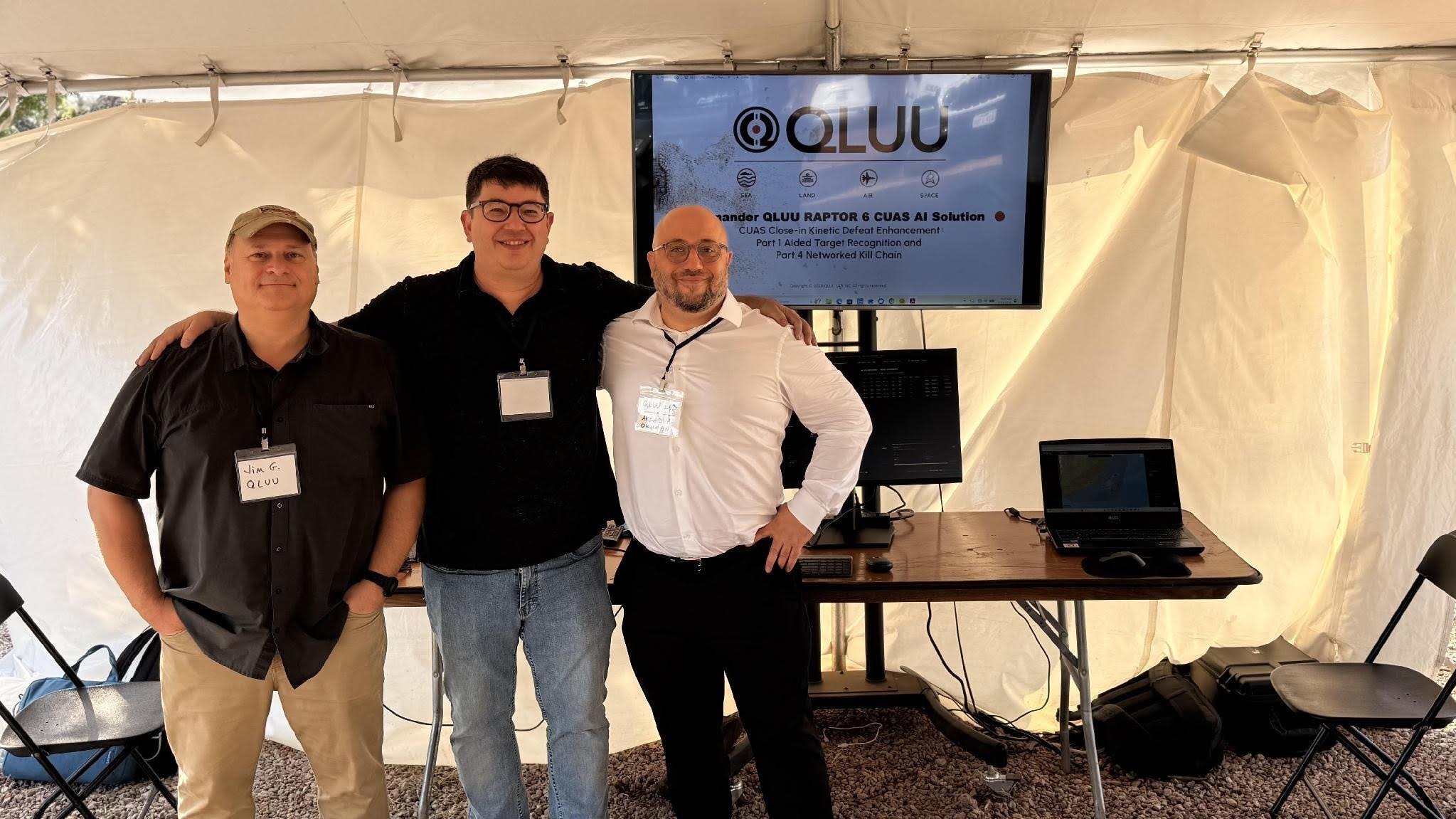
From left: Qluu Lab’s Lt Col (Ret.) James Gavrilis alongside Co-Founders Michael Jacobs and Arkadiy Okhman demonstrating Qluu’s autonomy software at a Defense Innovation Unit (DIU) field event. (Photo: Qluu Lab)
Tested outdoors on live flying drones and ground vehicles—and trained across nearly 700,000 physics-simulated trajectories—Qluu’s hardware-agnostic autonomy software runs offline at 12 watts without data-center GPUs.
LOS ANGELES — November 2026 — While Silicon Valley’s headline “world models” generate video pixels on power-hungry cloud GPU clusters, Qluu Lab Inc., a U.S. defense and dual-use autonomy software company backed by the Techstars New York Accelerator, is taking world models off the screen and onto real moving machines. Today, Qluu announced that its physics-grounded world-model and autonomy software has been demonstrated in live outdoor trials aboard flying drones and ground vehicles—running entirely offline on an off-the-shelf $80, 12-watt processor.
Qluu Lab is a pure-play software company: it does not manufacture drones, ground vehicles, sensors, or compute boards. Instead, domestic manufacturers and infrastructure operators run Qluu’s software stack on inexpensive commercial ARM processors integrated onto their existing vehicles and perimeter sensors—avoiding the cost, battery drain, heat, and supply-chain bottlenecks of $2,000 to $5,000 onboard GPUs.
Aligned with federal and Department of War Super Intelligence (SI) priorities under the Pentagon’s newly designated Super Intelligence Office (SIO), Qluu delivers sovereign edge physical intelligence with built-in human-on-the-loop controls. Rather than forcing hardware makers to spend years and millions of dollars building a custom AI stack for every vehicle hull, Qluu provides one reusable software brain.
Following closed-loop command-and-control field experimentation at Fort Hood, benchmark evaluation across nearly 700,000 physics-simulated trajectory windows, and live multi-vehicle outdoor trials in California this November, Qluu Lab highlighted four capabilities:
- World Models That Work in Physical Reality—Substantially Outperforming Physics-Only Filters: Qluu pairs compact learned models with hard physical bounds so vehicles predict how real objects move in three dimensions without hallucinating unsafe maneuvers. Across both held-out multi-domain simulations and live outdoor drone and ground-vehicle trials, Qluu’s world models substantially outperformed standard physics-only tracking filters while enforcing human-governed safety rules.
- Nearly 700,000 Simulated Trajectories — With Near-Identical Sim-to-Real Execution: Before flying outdoors, Qluu’s models were trained, tuned, and evaluated across 687,137 physics-simulated multi-domain trajectory windows (including more than 76,000 held-out test windows never seen during training) in simulation environments built on the IEEE 1278.1 Distributed Interactive Simulation (DIS) standard. Because Qluu runs the same software stack in simulation and on the vehicle, missions rehearsed in Qluu’s digital-twin simulator produced nearly identical actions and flight behavior during live outdoor drone and ground-target trials in California—letting partners test and verify missions on a laptop before ever heading to a flight range, while undersea autonomy and ground-based orbital command-and-control capabilities continue advancing in simulation.
- Resilient Coordination Over 32-Byte Messages When Links Degrade: Rather than relying on fragile live video feeds that stall in contested or bandwidth-starved environments, Qluu-equipped vehicles share target custody and coordinate using compact 32-byte messages—cutting message payload data by more than 99.9% compared with standard compressed camera frames and recovering cleanly after communications blackouts.
- Passive Multi-Sensor Drone Awareness for AI Data Centers & Critical Infrastructure: Because federal FAA and FCC rules restrict private operators from jamming drones or transmitting disruptive radio signals, Qluu’s software fuses a facility’s existing cameras, acoustic arrays, and perimeter radars without adding radio-frequency jammers—dramatically reducing 3D tracking error to help protect AI data centers, power substations, and ports.
“Everyone in tech is talking about world models, but most of them stay trapped inside a data center generating video,” said Michael Jacobs, Co-Founder of Qluu Lab Inc. “Real autonomy has to work outdoors when the wind is blowing, bandwidth is tight, and the entire compute budget is twelve watts on an $80 board. By proving physics-grounded world models on live vehicles in the field, we give American hardware makers and infrastructure operators practical physical intelligence they can license today.”
Note: Participation in field experimentation at Fort Hood or Defense Innovation Unit (DIU) events does not constitute endorsement, certification, or procurement by the U.S. Army or the Department of War. Detailed benchmark reports are available to qualified U.S. defense and commercial partners under NDA.
About Qluu Lab Inc.
Qluu Lab Inc. is a U.S.-owned defense and dual-use autonomy software company based in Los Angeles, California, co-founded by Arkadiy Okhman and Michael Jacobs. Backed by the Techstars New York Accelerator, Qluu Lab licenses hardware-agnostic physical world models, passive multi-sensor fusion, and digital-twin simulation software across air, land, maritime, undersea, space command-and-control, and critical infrastructure—manufacturing zero vehicles or hardware so it never competes with its OEM partners. Learn more at https://qluulab.com.
Media & Partnership Contact: Credible PR (for Qluu Lab Inc.) · max@crediblepr.com · https://qluulab.com
Written in partnership with Tom White
Documentary
Beyond the Spotlight: What Matthew Perry’s New Documentary Reveals About Addiction, Success and the Road to Recovery

Courtesy of The Turn Recovery
As Perry’s story returns to the spotlight, The Turn Recovery, a California treatment center, offers a fresh perspective on addiction and recovery.
Matthew Perry had what millions of people spend their lives chasing: fame, fortune, a successful career, and the affection of colleagues and audiences worldwide.
Yet behind the quick wit and unmistakable charm of Chandler Bing was a man fighting a deeply personal battle with addiction, one that continued despite his extraordinary professional success and access to treatment.
Now, three years after his death at 54, Perry’s story is back in the spotlight with Netflix’s new three-part documentary, The One About Matthew Perry, which premiered October 27. Featuring interviews with family members and longtime friends, the series offers a closer look at the man behind one of television’s most beloved characters.
His story raises a much larger question: Why is recovery so complicated, even for people who seemingly have every resource available to them?
It’s a question that professionals at The Turn Recovery, a newly opened private residential addiction treatment center in Healdsburg, California, are approaching with a philosophy centered on treating the whole person, not simply the addiction.
For Dr. Tim Worden, The Turn’s clinical director and a licensed neuropsychologist with more than 25 years of experience in addiction treatment programs, understanding the emotional, psychological, and behavioral factors behind substance use is essential to developing an effective treatment plan.
Addiction Doesn’t Discriminate
The image of someone struggling with addiction rarely tells the whole story.
It can be a young adult just beginning a career, a parent raising children, a successful entrepreneur, a healthcare professional or a retired executive. It can affect people across every income bracket, profession and generation.
And sometimes, the people struggling the most are the ones who appear to be doing exceptionally well.
In a world where professional success and outward appearances can mask personal struggles, that reality can be particularly difficult to recognize.
Someone can manage a business, maintain relationships, and fulfill professional responsibilities while privately struggling with a serious substance use disorder.
This is sometimes described as high-functioning addiction, although the term is not a formal medical diagnosis. In fact, it can be misleading, suggesting that someone who continues to perform well is somehow less vulnerable to the consequences of addiction.
For people accustomed to being in control, acknowledging the need for help can be especially difficult. Fear of professional consequences, embarrassment, or disappointing loved ones may create additional barriers to treatment.
Perry’s experience challenged the assumption that professional achievement, financial security or public admiration somehow protects a person from addiction.
The consequences extend far beyond Hollywood.
According to the California Department of Public Health’s 2026 State of Public Health Report, drug overdose was the leading cause of death among Californians ages 25 to 54 in 2024. It also ranked first statewide when measured by years of life lost, underscoring the devastating impact of lives cut short.
The problem extends far beyond California. Globally, an estimated 64 million people were living with drug use disorders, according to the United Nations World Situation with Regard to Drug Abuse (2026), highlighting the enormous reach of addiction across countries, cultures, and communities.
Behind those statistics are families, friends, and communities searching for answers.

Courtesy of The Turn Recovery
Why Recovery Requires More Than Detox
For decades, much of the public conversation around addiction has centered on getting sober. But stopping substance use, while essential, is only one part of a much larger process.
Substance use disorders can involve complex interactions among brain function, mental health, trauma, relationships, and physical health.
Dr. Worden’s clinical work focuses on these interconnected factors, including unresolved loss, trauma-related anxiety, guilt, shame, and relationship challenges that can accompany addiction.
At The Turn Recovery, that perspective helps shape an individualized approach to treatment.
Two people may arrive with the same diagnosis but have completely different histories. One may be struggling with unresolved trauma or anxiety. Another may be dealing with grief, relationship difficulties, or years of unhealthy coping mechanisms.
Even their definitions of a meaningful life in recovery may be entirely different.
The Turn’s treatment model combines medical and clinical care with opportunities to develop healthier routines, reconnect with personal interests, and build skills that support life beyond treatment.
The center also provides medically supervised detoxification, medication-assisted treatment when appropriate, and care for co-occurring mental health conditions.
The objective is not simply to address substance use, but to understand the individual circumstances that may contribute to it and develop a treatment plan that reflects those needs.

Courtesy of The Turn Recovery
Creating a Different Kind of Recovery Experience
That philosophy helped shape the vision behind The Turn Recovery.
Co-founder and managing partner Keith Greenberg brings more than 35 years of healthcare experience, including leadership in behavioral health and addiction treatment.
Throughout his career, Greenberg has seen how programs can be clinically sound yet still fall short of addressing the individual sitting in front of the treatment team.
When he joined forces with his co-founders, Jonathan and Patrick Wilhelm, whose background includes owning and developing premier golf and hospitality properties, they saw an opportunity to create a residential treatment environment that combined individualized clinical care with experiences designed to support personal growth.
Located in Sonoma County, The Turn integrates evidence-based treatment with wellness, outdoor activities and experiential opportunities tailored to each person’s recovery needs.
One of its most distinctive features is its relationship with Mayacama, one of the country’s premier private golf clubs, which is co-owned by the Wilhelm brothers.
That relationship provides opportunities to incorporate golf into the recovery process when clinically appropriate, including for individuals who have never played the game.
And the connection goes well beyond recreation.
Golf requires patience, focus, emotional regulation, and the ability to move forward after a setback. Those same skills can be valuable throughout recovery and in everyday life.
Every golfer knows that one bad hole doesn’t have to ruin an entire round. Similarly, a setback in recovery doesn’t have to erase the progress someone has made.
Golf is only one option. The Turn also incorporates creative outlets and other experiential activities based on individual treatment goals, complementing the clinical work taking place at the center.
For successful professionals who may have spent years defining themselves through achievement, responsibility, and performance, treatment can provide an opportunity to reconsider what a healthy, meaningful life looks like beyond their careers.
Changing the Conversation About Addiction
Matthew Perry’s legacy extends well beyond the television character that made him famous.
During his lifetime, he became an outspoken advocate for people struggling with addiction, openly discussing his own experiences and expressing a desire to be remembered for helping others.
His willingness to speak publicly about substance use disorders helped challenge the stigma that continues to prevent many people from seeking care.
The renewed attention surrounding his life offers another opportunity to move that conversation forward.
It’s also a conversation that reflects the philosophy behind The Turn Recovery: People struggling with addiction are more than their diagnoses, and effective treatment must recognize the individual behind the illness.
Recovery may involve medication, psychotherapy, family support, behavioral changes and the gradual rebuilding of relationships and routines. There are no guarantees or shortcuts, but effective treatment and sustained support can make recovery possible.
Perhaps the most meaningful lesson from Perry’s story is not simply that success cannot protect someone from addiction.
It’s that no matter how successful someone appears to be, how many times they’ve struggled or what their circumstances may be, they deserve the opportunity to heal, rebuild, and move forward.
To learn more about The Turn Recovery and its approach to individualized addiction treatment, visit the official website.
Written in partnership with Tom White
Wellness
Personal Fitness Coaching Isn’t Just for Celebrities, Says QBod Founder

With Thanksgiving gatherings, holiday parties and year-end deadlines approaching, founder Michele Balco wants fitness guidance to fit the life you actually lead
In Los Angeles, personal attention has long been part of the celebrity wellness equation. Training sessions fit around filming schedules, nutrition plans accommodate travel, and someone is available to help work through the details. For socialites and stars heading into a season of holiday parties and public appearances, having that kind of support becomes especially important.
Fitness and wellness coaching app QBod brings personalized guidance for busy schedules, from influencers juggling appearances and travel to parents balancing work, school pickups and holiday plans. Its AI coach, Coach Q, considers nutrition, training, sleep, recovery and personal goals together. Users can discuss how to approach a workout between events or adjust their routine while visiting family.
Founder Michele Balco developed QBod after encountering those competing demands herself. With Thanksgiving approaching and December invitations beginning to arrive, her approach speaks to a familiar wish: having help making a healthy routine work around your life.
The Founder Behind the Coach in Your Pocket
Before founding QBod, Balco spent more than 20 years at a Fortune 100 financial services company, leading strategic portfolios and large-scale technology projects. The idea grew out of her own efforts to balance that career with family life and fitness. She was using separate apps to manage different parts of her health, then trying to make sense of the information herself.
“My food app didn’t know I had slept four hours, and my workout app couldn’t account for it,” she says.
Balco’s experience reflects a broader frustration with managing multiple health apps. A 2026 survey commissioned by MD Live by Evernorth found that respondents used an average of six health-related apps. More than half said they had too many to manage, and nearly half reported weekly burnout from logging, alerts and updates.
Balco built QBod to bring that information together. Coach Q draws on users’ workout histories, food logs and sleep data to offer guidance based on their goals and daily circumstances.

Personal Attention Beyond the Celebrity Circuit
The appetite for a more individual approach to wellness reaches well beyond Hollywood. McKinsey’s 2025 Future of Wellness research found that 84% of U.S. consumers considered wellness a top or important priority. It also described younger consumers’ growing emphasis on daily, personalized practices across fitness, nutrition, sleep and mindfulness.
QBod brings that focus to decisions that might otherwise leave someone searching through general advice. Users can explain that they have limited equipment, a shorter window to train or a disrupted schedule, then discuss an approach that takes those details into account.
For someone leaving a studio lot and someone finishing a shift before picking up the kids, the question may be much the same: what can I realistically do today to keep moving toward my goal?
A Routine That Travels With You
The Wednesday before Thanksgiving offers a familiar test. Work runs late, a suitcase needs packing, and the hour set aside for the gym has become 30 minutes before leaving for LAX.
A user can ask Coach Q for a workout that fits that window and their training goals. Once away, they can explain how their meals, schedule or access to a gym have changed and discuss adjustments.
That conversation can continue through Hanukkah, Christmas and the year-end party circuit. A hotel gym might replace a usual training space, while a late evening could prompt a discussion about recovery before the next session.
Having somewhere to work through those changes can help make a busy season feel more manageable.

Tracking Habits, Not Just Results
QBod’s Q-Score tracks daily follow-through across nutrition, fitness and recovery. It reflects actions taken toward a goal, rather than serving as a health grade or measuring results.
“You can’t make the scale move on a Tuesday, but you can hit your protein target, get your workout in and protect your sleep,” Balco says.
During the holidays, that perspective gives a shorter workout or attention to recovery a place in the bigger picture. It also reflects the practical concern that led Balco to build QBod: people want guidance that considers their lives, including the weeks when very little goes according to plan.
Written in partnership with Tom White
-

 4 years ago
Maggie Jenson Is Empowering People Battling Addiction
-

 Crypto10 months ago
The Real Story Behind teemchase’s Real Estate, Music, and Crypto Empire
-

 3 years ago
Latino Pulse in LA’s Hip-Hop Heart: The FACEvsIT Evolution
-

 Fashion3 years ago
From Brothers to Business: The Inspiring Journey of YoungLA
-

 Entertainment3 years ago
From ‘Cold’ Streetwear to Cosmic Dreams: The Ryley Gauthier Odyssey
-

 Entertainment3 years ago
Yolo Aventuras: From Venezuela to Global Stardom – The Rise of Digital Content Creators
-

 5 years ago
Demonstrating the power of social media- British bombshell, Bonnie Locket:
-

 Business2 years ago
Iron Wallet: The Ultimate Solution for Financial Independence