
Jay Krymis Brings Community Back to the Bar Scene in Los Angeles

It only takes a few minutes inside Mic’s Bar in West Hollywood to figure out what owner Jay Krymis values most. With more than forty years in the hospitality industry, he’s seen technology, design, and customer expectations evolve every year, but one thing has never changed.
“Community is still what has not changed,” he said. “We are human. We need to socialize. That will never change.”
Mic’s Bar was built around that belief. Krymis wanted to create a true neighborhood watering hole, a place that feels friendly, affordable, and free of pretense. While some nearby spots rely on exclusivity or trends to draw a crowd, Mic’s focuses on connection.
It’s meant to be one of the most approachable and community-driven bars in Los Angeles, where people can relax and feel at home.
From the moment he opened his first bar, Krymis knew he had found his calling. He takes pride in creating spaces where guests feel safe, comfortable, and free to be themselves. To him, hospitality has always been about people and their shared need for belonging.
In a world that often feels disconnected, he hopes Mic’s Bar will continue to bring people together and strengthen the community around them.
Finding Purpose in Performance
Krymis’s story starts far away from Los Angeles. He grew up in Kalamazoo, Michigan, in a small farming community where family meant everything. His Mexican grandmother played a defining role in his upbringing, teaching him how to work hard and treat people with respect. She believed in him long before anyone else did, encouraging his early interest in acting.
After moving to Philadelphia, Krymis took his first job as a dishwasher at a seafood restaurant in a nearby suburb. He worked there after school and on the weekends, grateful to be part of a close-knit staff that welcomed him with open arms. As someone who loves people, he enjoyed getting to interact with the customers, who always seemed to be in good spirits.
Krymis graduated from Temple University in Philadelphia and went to graduate school in Budapest. Not long after completing school, he decided to follow his creative instincts and pursue a career in entertainment.
What started as a passion quickly turned into a lifelong career, taking him from movie sets to television studios. He’s appeared in films such as “Traffic,” “Tall Tales of the Wild West,” “Gladiators,” “Prepare to Die,” “Christmas Eve,” and “Jim Bridger.”
Success followed with several Best Supporting Actor awards and a Screen Actors Guild Award for his performance in “Traffic.” Krymis eventually moved behind the camera himself, producing and selling his own eight-episode TV series called “In the Big House” to Viacom.
Recently, he booked a nationwide commercial campaign and is preparing for a three-picture movie deal that will begin filming soon.
Acting remains one of his greatest passions, giving him a sense of creative freedom. Though his schedule is often packed with entrepreneurial ventures, he’s grateful for the flexibility that allows him to keep pursuing the work he loves, whether it’s studying, auditioning, or working on acting projects.
Over time, Krymis has realized how naturally performance and hospitality fit together. Whether on stage, on set, or behind the bar at Mic’s, the goal is to keep people engaged.
“The common denominator with acting and the hospitality industry is of course entertaining,” he said. “I love entertaining.”
He encourages his team to see themselves as hosts of an experience rather than just staff behind a bar. Every guest who comes through the door, he believes, should have a genuinely enjoyable time.
For Jay Krymis, the magic of Mic’s or any other establishment isn’t found in the décor or the lighting, but in the people who fill the space. The connections and conversations are ultimately what make guests want to return.
The Art of Entertaining
Even as his acting career has grown, he’s never left the service industry behind. Over the last four decades, he has opened, managed, and consulted on numerous restaurants and bars across Philadelphia, New Jersey, Delaware, and Southern California.
Some of his most notable projects include “66” Restaurant and Bar on Sunset Boulevard, the West Hollywood landmark Fubar, Padre in Long Beach, Schmitty’s in WeHo, and several Mezcalero locations. His commitment to helping the local community thrive has not gone unnoticed, earning recognition from the City of West Hollywood, the California Senate, and the Hollywood Chamber of Commerce.
Alongside his wife, he also owns Book’d Talent, an extras casting agency that connects aspiring performers with opportunities in film and television.
Krymis was inspired to open Mic’s Bar after reading an article about how neighborhood bars were disappearing across the country. It reminded him of a time when local spots served as the heart of a community — places where people could come together to celebrate, unwind, and connect.
“The newer generation bars are focused on the fancy cocktails and a cool aesthetic but often forget the whole point,” he said.
Wanting to bring that feeling back to West Hollywood, he set out to create a space that felt genuine, familiar, and safe. Mic’s offers good drinks at fair prices, a welcoming atmosphere, and a sense of belonging for every guest. The bar sponsors local sports teams, doesn’t charge a cover fee to get in, and puts people first.
“My wife Michel embodies that friendly, open heart attitude,” he said. “We named the bar Mic’s after her.”
All for One, One for All
After years in hospitality, Jay Krymis has learned that leadership means working alongside your team, not above them. He’s known for jumping into any role when needed and believes that every employee contributes to the business’s success.
Experience has taught him that the best leaders hire people whose strengths complement their own, and that became even more apparent during the COVID-19 pandemic. Like most restaurant and bar owners, Krymis experienced significant financial challenges and has been trying to catch up ever since.
“I really rely on my team,” he said. “I have realized over the years that I can’t do everything by myself and that I do not know everything.”
He’s also learned that running a restaurant or bar requires his constant presence and involvement. It’s not a business that can run itself, and the pandemic reminded him of that more than ever.
To Krymis, leadership comes down to teamwork, trust, and showing up for one another day after day. He treats his staff like family, just like he experienced at his first job, hoping they’ll continue to pass down those values in their own lives.
By leading by example and working together toward a shared goal, he inspires his team to take pride in their work and care about other people as much as he does.
That care for other people also extends into the greater community. Giving back, he says, isn’t separate from business, but a part of it.
“Recently my driving force has been to be of service,” he said. “Yes, we are a business but besides the bottom line it is important to me that we are a positive force in the community.”
Krymis has long supported APLA, Food on Foot, and Chrysalis, three nonprofits in Los Angeles that help with food insecurity, homelessness, and job placement.
A Legacy of Connection
After years spent balancing careers in both film and hospitality, Jay Krymis views success differently than he once did. It’s no longer about ambition or constant growth, but about slowing down and putting his energy into what makes him happy.
Doing what he loves, making a living from it, and giving back to others now define his sense of purpose. He feels grateful to have reached a point in life where work and meaning align, and where community service has become an integral part of his journey rather than an afterthought.
His life today feels grounded between the two places that shaped him most: the small Michigan town where he learned the value of hard work and family, and West Hollywood, the city that helped him grow as an entrepreneur.
Though the local market can be competitive and regulations strict, he considers it a privilege to build his business in such a supportive community.
“The community is amazing,” he said. “The LGBTQ community, the neighborhood, and the folks at city hall all seem to be rooting for us.”
Now in his mid-fifties, Krymis has slowed his pace but not his passion. Decades in the industry have reaffirmed what he knew from the start, that hospitality is where he belongs.
From his early days washing dishes to opening bars of his own, the magic has always come from creating safe, fun places where families can gather, connect, and celebrate life together. Krymis hopes the businesses he’s built will keep thriving and serving their communities long into the future, continuing to offer the same welcoming spirit that have always guided his work.

Entertainment
The Future of Performance: Why the Dance World is Watching Quinn Fieldstone

In the high-stakes world of professional dance, the transition from principal artist to industry architect is a leap few execute with true technical authority. Quinn Fieldstone is delivering a masterclass in that evolution. She is not simply teaching choreography. She is redefining the standard of how elite dancers are trained, developed, and prepared for the professional stage.
Fieldstone’s authority is not theoretical. It was forged under the demands of the world’s most rigorous performance environments. She launched her career at just 14 as a principal dancer with Jeunesse Classique Ballet, performing leading roles such as the Sugar Plum Fairy in The Nutcracker, Swanhilda in Coppélia, and Myrtha in Giselle. This was not simply an early start, but the beginning of a career defined by sustained excellence. Her trajectory continued through her work as a leading soloist with Ballet Ouest and her distinguished tenure with the Virginia National Ballet, where her refined artistry and leadership earned her the role of Assistant Ballet Master, a position reserved for artists with exceptional technical command and professional insight.

What sets Fieldstone apart on a national level is the extraordinary refinement and versatility of her technique across all styles of dance. Her foundation in classical ballet is marked by precision, control, and purity of line, while her fluency in contemporary, jazz, and commercial styles reflects a rare adaptability and depth of movement quality. This seamless command across disciplines allows her to move effortlessly between the structure of classical technique and the dynamic, expressive demands of modern choreography. As a result, she has become a highly sought-after performer and choreographer, trusted to deliver work that is both technically rigorous and artistically compelling.
Fieldstone’s choreography is distinguished by its ability to merge technical integrity with emotional resonance. Her work bridges classical structure with contemporary innovation, creating movement that is both disciplined and powerfully expressive. This unique voice has led to widespread recognition, including numerous top placements at premier regional and national competitions, as well as multiple awards for choreography. Her pieces consistently stand out for their clarity, musicality, and ability to connect with audiences on a profound level.
To observe Fieldstone in the studio is to witness a master of both technique and communication. She possesses a rare ability to translate complex movement into accessible, actionable instruction, elevating dancers from foundational training to professional caliber performance. Her teaching emphasizes not only technical excellence but also anatomical awareness, injury prevention, and longevity, ensuring that dancers are equipped for sustainable careers in the performing arts.
Fieldstone’s impact extends beyond performance and choreography. She represents a new standard of leadership within the dance industry, one that prioritizes both artistic excellence and the holistic development of the dancer. Her ability to integrate discipline, versatility, and innovation has positioned her as a leading figure in shaping the next generation of performers.
Quinn Fieldstone is not simply participating in the evolution of dance. She is actively defining it.
Written in partnership with Tom White
Music
Colby Kline’s Avalanche Is Her Darkest, Grooviest Single Yet
Colby Kline is an independent music artist who recently released a new album, AVALANCHE. Described as “dark, groovy, and hypnotic,” the album is a new direction for Kline, who pairs her siren-esque voice with seductive, moody synth-infused sounds.
Kline, who lives in West Hollywood, is an LA singer-songwriter who draws on her collaborative writing experience, vocal training, and love of a wide range of musical genres to create a lush, dark pop sound. The new release is a refinement of her artistic style and a step forward in her musical career.
An Early Introduction to Performance
Kline grew up in the hills above Mulholland Drive in Los Angeles, the daughter of comedian and actor Richard Kline. Her father’s famous role on Three’s Company was an early introduction to the entertainment industry, and Kline describes this time as an “immersive introduction to show business.” The insight she gained from witnessing her father’s career helped her shape her future ventures in the creative world.
The multi-talented Kline soon followed in her father’s footsteps and, at a young age, began acting, singing, and modeling in commercials, film, and television. Her impressive vocal talents led to her being featured as a vocalist with the Pasadena Pops Orchestra before the age of 14.
As a young actress, Kline also enjoyed roles in the films Just Go with It (2011), Problem Child (1990), and The Last Boy Scout (1991).
Formal Training and Musical Education
Though Kline had early success in her acting career, she chose to focus on her musical talents while attending Northwestern University. She studied musical theater and vocal performance, which would become the foundation for her future indie music career. Kline’s education was essential to developing her range, her nearly perfect pitch, and her vocal style.
Though she had enjoyed early success in her acting career, Kline decided to pivot after graduating and pursue a music career.
The Transition to Songwriting and Composing
In 2009, Kline began recording professionally and collaborated with a member of Tears for Fears. It was during this time that she realized being in the recording studio and songwriting was more “creatively fulfilling” than her previous acting work. This revelation pushed Kline to explore more musical opportunities, which eventually led her to take full control of her career by creating her own imprint.
Later, she would move to Brooklyn, where she found what she calls a “grittier, more intimate creative world.” While living there, Kline was approached to co-score a feature film, Ovum. It was her experience composing for the screen that solidified her love for “dramatic, cinematic musical soundscapes” that would later influence AVALANCHE.
West Hollywood Musician
With the AVALANCHE single, Kline is pushing further into the independent music scene in Los Angeles. She has a strong commitment to maintaining creative control over her musical endeavors and the direction of her career.
Skin on Skin is one of Kline’s most-streamed tracks, and AVALANCHE confirms her relevance in the indie music scene. Her love of dramatic, atmospheric, mood-driven music pours out of her latest creation.
Kline has cultivated a distinctive sound with her cinematic indie pop and plans to continue infusing her solo work with influences from a wide range of genres. She also aspires to score for film and television.
AVALANCHE is a bold departure from Kline’s previous work and showcases her intense dedication to crafting hypnotic music that enchants listeners. As her Instagram bio says, Kline is “not your eye candy but your soul food.”
Written in partnership with Tom White
Restaurant
Old Hollywood, New Horizons — The Smoke House’s 80-Year Journey
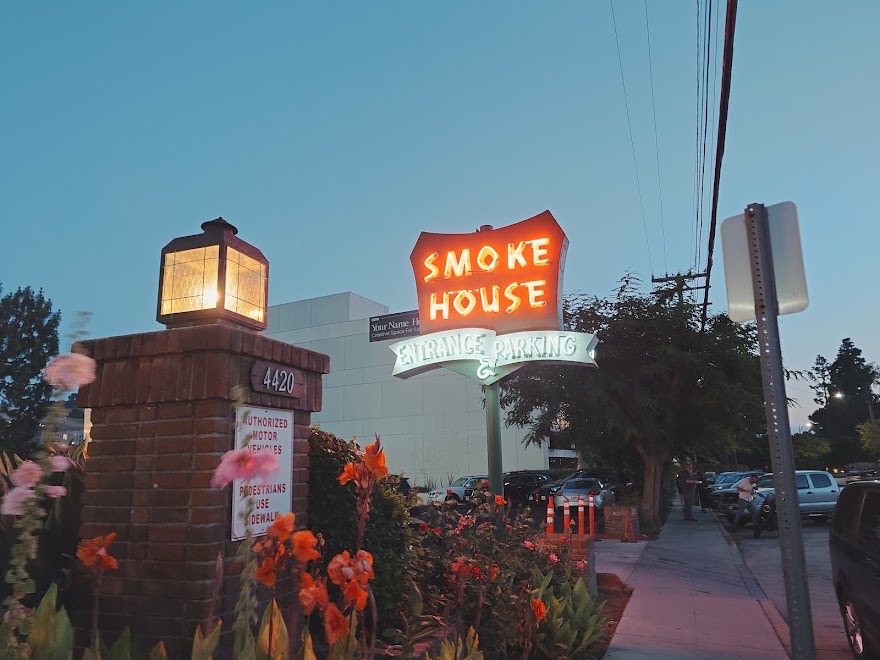
The burgundy booths at the Smoke House restaurant have witnessed everything from whispered deals to surprise serenades. Actor George Clooney so loved the place that he named his production company Smokehouse Pictures after the booth where he and Grant Heslov would scheme over martinis. It’s a fitting tribute to a steakhouse that has served as Hollywood’s unofficial clubhouse since 1946.
The restaurant began as a 46-seat chophouse at the corner of Pass Avenue and Riverside, frequented by stars like Bob Hope and Bing Crosby. Three years later, it moved to a Tudor-style inn across from Warner Bros. Studios and expanded again in 1955 under architect Wayne McAllister, growing to 18,000 square feet. Today it seats more than 500 people amid fireplaces, director’s chairs, and classic movie posters. A neon sign outside still flashes the motto “fine food at a fair price,” a promise that has endured since 1946.

For decades, the Smoke House has blurred the line between reality and the silver screen. Casts from “Friends” and “ER” gathered here after taping, while Judy Garland and Robert Redford were among its many regulars. Live music fills the lounge on weekends, drawing performers like Joni Mitchell, who celebrated her 80th birthday at the restaurant. The menu’s icons—prime rib with horseradish, creamy pastas, and that famous garlic cheese bread—remain unchanged, even as the kitchen sources more sustainable ingredients and modernizes its cocktail program.
Asked how the restaurant stays relevant in a city obsessed with reinvention, Smoke House management says the secret lies in preserving the “soul” of the place while meeting contemporary standards. Dim lighting, red booths, and genuine hospitality create a sense of continuity, while updated service, inclusivity, and sustainable sourcing appeal to modern diners. They describe the steakhouse as an “industry sanctuary” where patrons can finalize deals or rehearse scripts without paparazzi lurking. The management team sees the restaurant as a bridge between eras, a living link where veteran directors and young actors share garlic cheese bread and stories.

The upcoming 80th anniversary celebration embodies that philosophy. In October, the Smoke House will revive its 1946 Throwback Menu—pricing signature dishes at $19.46—and host curated events that lean into its Old Hollywood roots. The restaurant will launch digital storytelling projects to capture the memories of longtime staff and patrons and continue its support of the Burbank International Film Festival, ensuring that future filmmakers will have a place to call home. “We aren’t just celebrating a date on a calendar; we’re celebrating 80 years of being a cornerstone of the community,” management said.
After 80 years, the Smoke House remains a rare constant in Los Angeles: a steakhouse where the past and present collide, where garlic bread is as legendary as the stars who dine there, and where the next chapter of Hollywood history is just a booth away.
Written in partnership with Tom White
-

 4 years ago
Maggie Jenson Is Empowering People Battling Addiction
-

 3 years ago
Latino Pulse in LA’s Hip-Hop Heart: The FACEvsIT Evolution
-

 Fashion2 years ago
From Brothers to Business: The Inspiring Journey of YoungLA
-

 Entertainment3 years ago
From ‘Cold’ Streetwear to Cosmic Dreams: The Ryley Gauthier Odyssey
-

 5 years ago
Demonstrating the power of social media- British bombshell, Bonnie Locket:
-

 Business2 years ago
Iron Wallet: The Ultimate Solution for Financial Independence
-

 Entertainment2 years ago
Check out Lil Wayne’s New Artist, Drizzy P
-

 Entertainment2 years ago
Yolo Aventuras: From Venezuela to Global Stardom – The Rise of Digital Content Creators