
Entertainment
Anand PKC: Painting a Vision for Art, Philanthropy, and Social Change
Overcoming Fear to Follow Dreams
Have you ever been afraid to follow your dreams? That nagging fear of leaving behind the familiar, risking security, and diving into the unknown can hold many people back. Yet, for those who dare to chase their passion, the rewards can be beyond imagination. It takes immense courage to walk away from a privileged life and what is expected, and to embrace the vulnerability of pursuing a dream. But this is often where the most extraordinary journeys begin. For Anand PKC, an acclaimed award-winning artist whose work now graces prestigious galleries worldwide, this very leap of faith transformed his life and career.
Early Life and Passion for Art
Anand’s story began in India, where he was born into a prominent family with a legacy of wealthy business success. From a young age, his path seemed predetermined—he was expected to follow in his father’s footsteps and manage the family’s business empire. However, Anand’s true passion lay elsewhere. By the age of three, Anand discovered his love for art, nurtured lovingly by his artist mother. Exposed to traditional Indian culture and modern influences, art ignited a fire within him that would burn bright for a lifetime.
Pursuing Art in the United States and Recognition
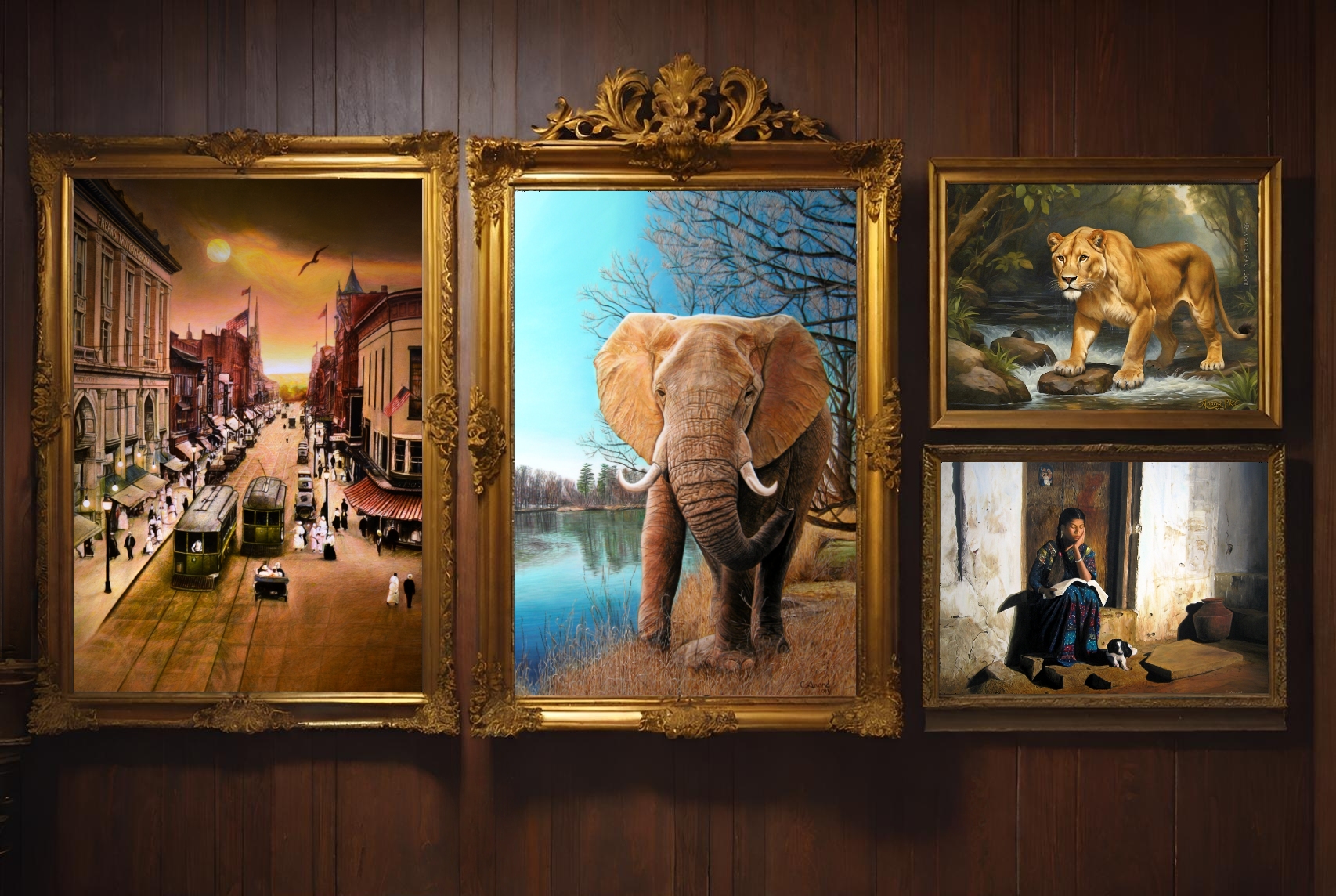
As he grew older, the magnetism of painting became impossible to ignore, and Anand made the bold, life-changing decision to leave behind his family’s expectations and move to the United States to pursue his artistic dream. That decision led him to New York City, where his first solo exhibition in Chelsea brought him instant recognition. His hyper-realistic paintings, rich in detail and emotion, captivated viewers and garnered widespread acclaim. Anand’s mastery of the hyper-realism technique, a rarely found style that meticulously captures the finest details of life, quickly made him a standout in the art world. Soon, his work was featured at iconic venues such as the United Nations Headquarters in New York and the Los Angeles Convention Center. Through these exhibitions, Anand solidified his reputation as an artist capable of creating visually stunning masterpieces. This led to his winning multiple accolades and serving as a juror for prestigious art organizations on the world stage.
Artistic Themes as a Call to Action for Global Causes
What sets Anand apart is not just his technical skill, but also the deeper meaning that serves as a powerful medium for addressing and raising awareness about critical global issues. His paintings, for example, “Spirit of India”, “Indian Beauty in Rainy Misty Foliage”, “A New Day Rising”, and “Taj Mahal of India,” embody themes of resilience and identity, beautifully merging his past, present, and the human relationship with nature. Anand’s art is not just a celebration of beauty; it is a call to action. Through his work, he seeks to raise awareness about issues such as poverty, wildlife and environmental conservation, and the need for global education. This alignment underscores how art can transcend aesthetics to inspire meaningful change.

Future Ambitions and Philanthropy
Anand’s ambition doesn’t stop with creating remarkable art. He envisions using his talent to raise over a billion dollars for causes close to his heart. To achieve this, he plans to launch two exclusive online art storefronts, “Art Millionaires” and “Art Billionaires”, which will sell and auction his own work alongside the works of other artists, including the old masters. The goal is to use art as a catalyst for change, with proceeds supporting philanthropic efforts that ignite change for a just society, lift people out of poverty, empower children through education, and protect our planet’s wildlife and environment.
Looking Ahead
As Anand looks to the future, his artistic journey continues to evolve. His upcoming series will explore themes of light and darkness, tradition and modernity, blending hyper-realism with surrealism and fantasy. Through this new body of work, Anand hopes to challenge perceptions and engage viewers in deeper reflection on the complexities of life and the world around us.
Anand PKC’s story is a powerful reminder that following your dreams, no matter how daunting, can lead to extraordinary heights. His journey from India to international acclaim is not just one of artistic success but of courage, purpose, and a desire to make a lasting impact on the world through the transformative power of art.
Visit his website at www.anandpkc.com and follow him on Instagram: @world.class.oil.paintings Facebook: Anand PKC Youtube: World Class Oil Paintings By Anand PKC

Entertainment
Keyla Wood and the Power of Playing by Her Own Rules

There is a particular kind of power in Hollywood that has very little to do with being the loudest person in the room. It comes from longevity, relationships, adaptability and understanding how culture moves before everyone else catches up. Keyla Wood has built her career around exactly that kind of power.
For decades, Keyla has lived inside entertainment as an actress, but her place in the industry has grown considerably beyond the roles she plays. From a substantial television career in Mexico to her work in American film, television and streaming productions, she has navigated two entertainment cultures while building an identity that belongs comfortably to both. Los Angeles became more than the city where she continued acting; it became the place where the different dimensions of her career began to converge.

Keyla Wood is part of a changing Hollywood in which cultural relevance is no longer defined by one job title. She acts, produces, develops projects, creates media, works with brands and has built TheWoodPr into an international public relations and image company. These are not side businesses surrounding an acting career. Together, they explain how she has learned to operate in an industry where talent may get someone into the room, but understanding people, perception and opportunity determines how long they remain there.
That perspective has also given Keyla influence beyond her own image. Through TheWoodPr, she has spent more than fifteen years positioning other actors, filmmakers, entrepreneurs, executives and companies, taking the same understanding of visibility that has shaped her own career and applying it to people with entirely different ambitions. Her professional world now moves naturally between Hollywood sets, business meetings, media, fashion, international relationships and cultural initiatives connecting Los Angeles with Mexico, Latin America, Europe and Dubai.

Perhaps that is what makes Keyla Wood particularly representative of Hollywood right now. She belongs to a generation that entered entertainment before followers, algorithms and personal brands became part of the vocabulary, yet she has successfully adapted to an industry increasingly driven by all three. She understands the traditional machinery of entertainment, but she also understands that today’s public figure can no longer depend entirely on that machinery. Keyla has consequently created her own.
Her acting continues. Her producing ambitions are expanding. TheWoodPr continues developing internationally. Her relationships within international media and entertainment have placed her in a position to amplify stories beyond her own, while her presence in Los Angeles keeps her connected to the constantly shifting intersection of entertainment, entrepreneurship and culture.

None of this happened overnight, and perhaps that is precisely the point.
Hollywood spends enormous energy searching for what is next. Keyla Wood’s story represents something different: the power of continuing to evolve until the industry has to reconsider what you are capable of becoming.
She is not simply maintaining a career. She is using everything that career has taught her to create the next version of it—and increasingly, to create opportunities for others along the way.
Written in partnership with Tom White
Entertainment
Speaking Volumes Without a Word: How Parinas Esmailsadeh Captured a Best Actress Win in Silence

Acting without the safety net of dialogue is a cinematic tightrope walk. When Parinas Esmailsadeh decided to step behind the camera for her directorial debut, she didn’t just write and direct the project she cast herself in the lead role of a completely silent film. It was a massive creative gamble, and it paid off brilliantly.
Her self-produced independent short, “And Then There Was Nothing”, is currently making waves on the international festival circuit. Most notably, the deeply personal project recently earned Esmailsadeh the highly coveted Best Actress award at the Indian Independent Film Festival.
Taking home a Best Actress trophy is a major milestone for any performer, but winning one for a role entirely devoid of spoken lines is a testament to Esmailsadeh’s profound on-screen presence. Without a script to lean on, she had to carry the entire emotional weight of the film through her physical performance alone.
The film itself is a quiet, intensely cinematic exploration of grief, loss, and the sudden, jarring realization of human mortality. By deliberately stripping away spoken dialogue, Esmailsadeh forces the audience to sit in the heavy, uncomfortable spaces of her character’s internal landscape. Viewers are drawn directly into the atmosphere of the film, relying on the pacing, the framing, and, most importantly, Esmailsadeh’s raw facial expressions to guide them through the story.
So, how does an actor successfully carry an entire film without saying a word? For Esmailsadeh, the secret lies in a deeply physical approach to character work, forged long before she ever stepped onto a movie set.

Fluent in German, English, and Farsi, and trained at both Germany’s prestigious Folkwang University of the Arts and Hollywood’s American Academy of Dramatic Arts, Esmailsadeh has always understood how to navigate across cultural and linguistic lines. But it is her athletic background that truly informed her silent award-winning performance. Years spent as a competitive show jumper in Germany, combined with rigorous training in boxing and dance, taught her a fundamental truth: the body doesn’t lie.
She understands intuitively how human psychology is revealed through subtle physical movement. In a silent film, the way a character breathes, where they hold tension in their shoulders, or how they choose to stand still essentially becomes the dialogue. Esmailsadeh has always believed that the camera captures these microscopic physical truths, a philosophy that guided every choice she made while directing her own performance.
Of course, the transition from acting to taking full creative control didn’t happen overnight. Before stepping into the director’s chair for And Then There Was Nothing, Esmailsadeh began exploring narrative structure by writing and starring in another independent film, Tied Up. That experience gave her a vital, 360-degree perspective on character motivation, ultimately giving her the confidence to build a story from the ground up that could translate across any cultural or language barrier.
As “And Then There Was Nothing” continues its successful festival run, Esmailsadeh is showing no signs of slowing down. Even as she sweeps up accolades for her deeply personal indie projects, she maintains a firm foothold in the mainstream studio system. Up next, she will appear in David Lowery’s highly anticipated A24 feature, Mother Mary, sharing the screen with Academy Award winner Anne Hathaway.
Looking ahead, Esmailsadeh is actively developing a slate of new original projects. Whether she is orchestrating a story from the director’s chair, modeling in international fashion campaigns, or delivering an award-winning performance in front of the lens, one thing is clear: she is an artist fiercely dedicated to exploring the complexities of the human condition, with or without a script.
About Parinas Esmailsadeh
Parinas Esmailsadeh is a working actress, writer, and filmmaker based in Los Angeles. She is a graduate of the American Academy of Dramatic Arts, having studied at both the Hollywood and New York campuses. Her career spans independent cinema, major studio features, and international high fashion. She is currently developing her next original projects while continuing her work as an actor and model.
Connect & Discover More:
IMDb: Parinas Esmailsadeh
Instagram: @pxri.th
Written in partnership with Tom White
Entertainment
K-SWAB and ATL ONFIYA: Building an Independent Media Empire

ATL ONFIYA is more than entertainment; it represents independent ownership, creativity, networking, and perseverance. Founded by K-SWAB, the company is seeking to innovate in critical ways within the entertainment industry.
The entertainment industry has changed profoundly over the past few decades. What was once a well-established, rigorous system and pipeline has now given way to much greater leniency and personal autonomy in the wake of streaming services and social media platforms. The barrier to entry has been drastically reduced in the wake of these new technological tools. The power is now in the hands of individual artists to forge their own paths, and that is exactly what K-SWAB aims to do with ATL ONFIYA.
About K-SWAB
Ackeo Stevenson, professionally known as K-SWAB, is a self-taught producer, hip-hop artist, music engineer, videographer, photographer, graphic designer, radio host, and entrepreneur. During his career, he has garnered experience and built ATL ONFIYA into an independent multimedia platform. Focusing on everything from entertainment and music to radio, television, artist branding, interviews, event coverage, and independent media exposure, K-SWAB’s background spans music production, artist development, television production, digital broadcasting, and entrepreneurial leadership.
As such, K-SWAB’s efforts uniquely combine multiple creative industries into a single cohesive ecosystem. Whereas others in the entertainment industry generally focus on a specific niche, K-SWAB is passionate about all these elements and seeks to bring them together into a unified front.
ATL ONFIYA is a distinctly modern platform, one that allows users to tap into entertainment across a wide range of media. K-SWAB’s perspective comes from being fully hands-on in every aspect of content creation and platform development while helping elevate independent creators and entrepreneurs.
The Inspiration Behind the Innovation
Through it all, K-SWAB’s personal story has remained rooted in self-development and persistence. Much of ATL ONFIYA was built independently through trial and error, creativity, and consistency. Early on, he learned how to engineer music, shoot visuals, edit content, and produce media without relying on large studios or investors. That independent mindset became the foundation of ATL ONFIYA’s growth, as he spearheaded every aspect of the project and remained deeply hands-on throughout its formation.
The lack of opportunities and exposure available to independent artists, creators, and entrepreneurs inspired K-SWAB. Rather than waiting for opportunities, he focused on building his own platform where creators could gain visibility, network, and grow their brands. ATL ONFIYA was created to bridge entertainment, business, culture, and media, helping independent talent gain real exposure.
Overcoming Obstacles
One of the main challenges was creating an independent media platform without support from large corporations. K-SWAB needed to acquire various skills on his own, including production, editing, engineering, branding, broadcasting, marketing, and business operations management.
Another difficulty was gaining recognition in highly competitive industries while maintaining independence. By staying consistent, networking, persevering, and self-educating, K-SWAB developed lasting media relationships and continued to grow the ATL ONFIYA brand.
A Brighter Future
Moving forward, K-SWAB is passionate about continuing to grow ATL ONFIYA, with ambitions to turn it into a nationally recognized multimedia network with expanded television distribution, larger artist development opportunities, major interviews, live productions, and broader international exposure.
He aspires to continue building platforms that help independent creators, entrepreneurs, and entertainers gain visibility. As the entertainment industry continues to shift in substantial ways, K-SWAB seeks to carve out his own path to success and invite other artists to join him on the journey.
Written in partnership with Tom White
-

 4 years ago
Maggie Jenson Is Empowering People Battling Addiction
-

 Crypto9 months ago
The Real Story Behind teemchase’s Real Estate, Music, and Crypto Empire
-

 3 years ago
Latino Pulse in LA’s Hip-Hop Heart: The FACEvsIT Evolution
-

 Fashion3 years ago
From Brothers to Business: The Inspiring Journey of YoungLA
-

 Entertainment3 years ago
From ‘Cold’ Streetwear to Cosmic Dreams: The Ryley Gauthier Odyssey
-

 Entertainment3 years ago
Yolo Aventuras: From Venezuela to Global Stardom – The Rise of Digital Content Creators
-

 5 years ago
Demonstrating the power of social media- British bombshell, Bonnie Locket:
-

 Business2 years ago
Iron Wallet: The Ultimate Solution for Financial Independence